
Convoys and Patrols
Entry posted by =VG= The_Polish_Guy in Green Tactics
404 views
The difference between a convoy and patrol might not be obvious at first, but understanding it is crucial for communication and effectiveness in the field.
A convoy consists of a set number of vehicles. Convoys have no tasks other than getting from A to B, quickly and safely. Usually it transport cargo, people or a VIP but can be adjusted as long as it is still tasked with transport. The main characteristics of a convoy are:
- A convoy does not stop on it’s route without the commander’s order. Only exceptions to the rule are a broken or destroyed vehicle, IED/mine or a road blockade.
- A convoy is not influenced by road signs and traffic regulations unless stated otherwise in the ROE.
- A convoy has a set speed and distance between convoy vehicles.
- Convoy vehicles have a set order which does not change unless ordered by the convoy commander.
- No third party vehicle is allowed to enter the convoy.
A patrol even if acts similar on the road has a completely different task. A patrol is usually tasked with: finding intel, maintaining presence, clearing roads, moving to a primary objective and so on. The main characteristics of a motorized patrol will be similar to a convoy, but will stop or change route to engage with present threats.
Planning
The planning process starts with the task we have to complete. If the task is transporting something or someone, we will plan for a convoy. If our task is more combat related we’ll prepare for a patrol.
Vehicle composition
This will heavily depend on what vehicles we have and what threats we expect to encounter. As a general rule the first at least two vehicles should be armed with the first vehicle being as well armed as possible. The middle part of a convoy/patrol will contain the supply/transport vehicles and any other vehicles that aren’t armed. The last vehciles will again be armed.
When expecting EOD threats the element leader should consider moving an EOD vehicle to the front. If there are not EOD vehicles, the designated EOD should be moved to the first vehicle which ideally is an MRAP.
Route selection
The route we choose will reflect our tasks. If we are tasked with conducting a convoy the perfect route should have as little threats as possible and as well scouted as possible. The decision making process will vary depending on the scenario, but the general rule is to minimize the chance of enemy contact.
Route selection for a patrol will be strictly tied to our task but it should still keep in mind the safety of the element. This decision making process will be even more varied and will be influenced by what the main task is.
Some of the AO characteristics to consider are:
- terrain features,
- size, shape and conditions of the road,
- villages, towns,
- friendly installations,
- civilian friendliness,
- permissiveness of the environment,
- need to stay undetected.
The element leader should also remember to plan contingencies in case of the route not being passable or too dangerous.
Speed and distance
Planning speed and distance between vehicles has to influence the cohesion of the convoy/patrol. Often different vehicles are limited to lower speeds so it is important to not leave them behind. Additionally the type of terrain should influence the speed. Tight roads, mountain climbs and towns will limit how quickly we can go while still maintaining safety.
Countering a roadblock
While moving in vehicles most of our movement is canalized. We stay on roads and rarely get off them. That makes it easy to stop or impede our path by setting up roadblocks. Depending on our task, vehicles and the type of roadblock different actions will be advisable. A lot of the time though, we will have to fight and overpower the enemy on the roadblock either to eliminate them or make them retreat.
There are obviously many ways of doing this. The one I will point out below is one of the simpler ones but that does not mean it’s not effective.
When encountering a roadblock the first vehicle should continue until it is in range to suppress or eliminate the barricade. If it is able to completely eliminate the threat there is obviously no need to do anything else. Often though we want to clear the barricade or we don’t have enough firepower in the first vehicle to completely wipe out the enemy position. In that scenario:
- Vehicle 1. drives off to the side starting a herringbone stop formation and opens fire at the barricade. If possible relays the best way (left/right) to approach the barricade.
- Vehicle 2. turns off road if possible and approaches the barricade at a 45 degree angle while closing the distance.
- The rest of the vehicles join the herringbone. If they are armed they can join the base of fire [vehicle 1.].
- Once the vehicle mounted guns cleared the barricade enough and we think there is a need to clear it out on foot, vehicle 2. will dismount the infantry and conduct clearing with the cover of all the vehicle mounted guns.
- When we are sure the barricade is not a threat, vehicle 1. moves past the barricade and the convoy/patrol order is reestablished.
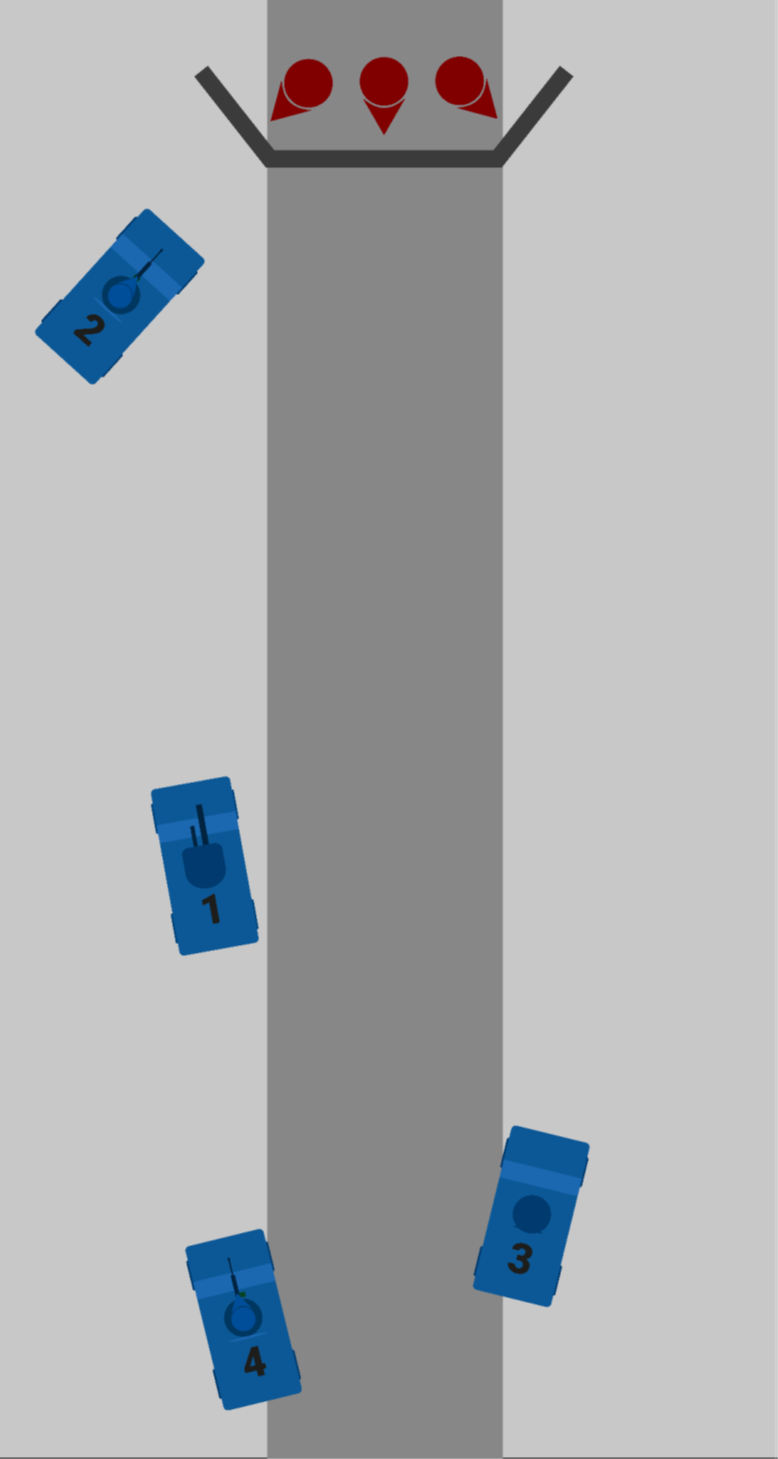
As you can probably see the goal of this tactic is to quickly and without input from the element leader set up a ‘hammer and anvil’ style position at the start of the fight, to either quickly overpower the enemy both with fire and maneuver or at least give ourselves a better fighting chance for the rest of the engagement.
Countering an IED
When an IED is encountered on the path of a convoy/patrol the element leader has to act quickly. An IED is often a signal for an enemy guerilla force to start an ambush. That’s why the priority of dealing with an IED should not be disabling the IED. If possible we of course want to go around it, while looking for other threats or disable the IED by shooting it with a vehicle mounted gun. Both options are very risky since we don’t know what kind of a force might be waiting to ambush us when we drive onto or past the IED an we don’t know if the IED is remote detonated or pressure plate detonated or how big the explosion radius might be. Additionally ROE will often prohibit us from detonating IEDs on roads or near other civilian infrastructure.
When we stop to counter the threat, the priority is setting up a security perimeter to counter any ambush. Only then can we send out the EOD specialists to deal with the explosive. It is important to be on a lookout for potential spotters, snipers suspicious vehicles in front and behind the formation or any features suitable for an ambushing force.
If we anticipate being stopped for a while it might be wise to proactively take control of any key terrain features around our position if we can spare some dismounted infantry.
Security sectors
Vehicle mounted guns and their gunners should follow the same rules as an infantry line formation in terms of watching sectors.
Halts
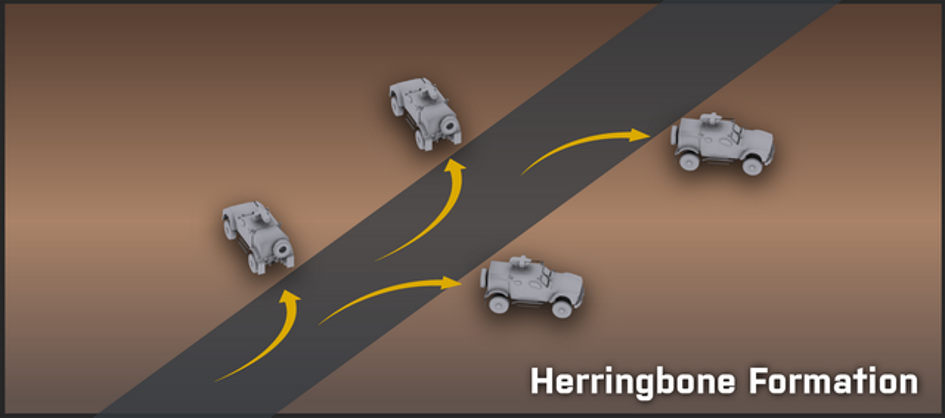
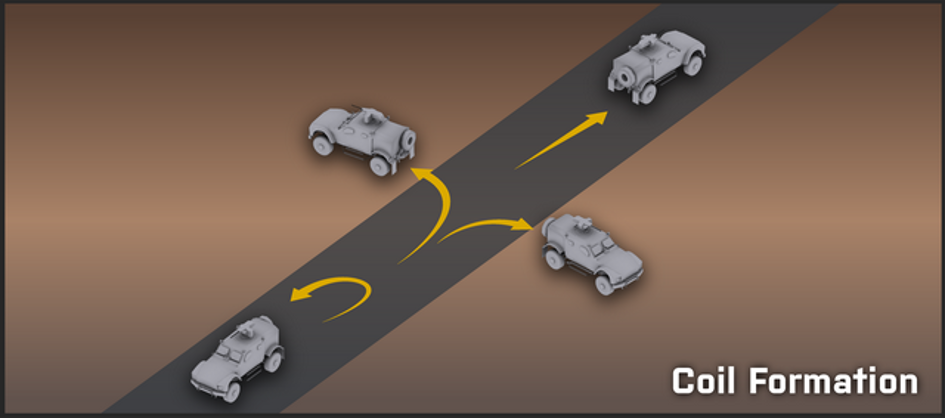
When stopping a convoy/patrol we want to keep security with either vehicle mounted guns or those and dismounted infantry. Another important thing is setting up our vehicles in a defensive formation. Below you can see a herringbone formation and a coil formation.
And here a coil formation
Common actions
Some of the most common commands an element leader might give or callouts made by others are:
- Push through – short and precise message telling the convoy/patrol to push through whatever it encountered.
- Assault through – this command indicates a dismount with cover fire from the vehicle mounted guns and subsequent assault.
- Vehicle down – is the callout made by someone who sees or otherwise knows that one of the vehicles has been disabled and can’t continue. The standard action should be to go around that vehicle and keep going if the convoy/patrol is being engaged (i.e. an ambush).
0 Comments
Recommended Comments
There are no comments to display.
Join the conversation
You are posting as a guest. If you have an account, sign in now to post with your account.
Note: Your post will require moderator approval before it will be visible.