
Call For Fire (CFF)
Entry posted by =VG= The_Polish_Guy in RTO & JTAC
203 views
Call for fire is used to call in artillery fire support. It would often be called in by Forward observers but in Arma it will usually be an RTO or a JTAC. I will break down the report into lines, similar to how CAS requests are structured.
|
CALL FOR FIRE (CFF) |
|
Prepare to receive call for fire |
|
1. Observer’s position |
|
Adjust Fire |
|
2. Target’s position: GRID, Altitude, Direction from observer
OR |
|
3. What the target is |
|
At my command |
|
Fire |
|
Fire Adjustments |
Fire adjustments:
- If the round hit left of the target, we call adjustment to the Right
- If the round hit right of the target, we call adjustment to the Left
- If the round hit in front of the target, we call Add
- If the round hit behind the target, we call Drop
Values for adjustments can be:
- Direction (measured by observer)
- Left / Right + distance in meters (minimal correction 30m)
- Add / Drop + distance in meters (minimal correction 50m)
Example
Steelrain, Steelrain prepare to receive call for fire
Steelrain copies
Steelrain, this is Raptor
at GRID 133 brake 124
adjust fire, over
Adjust fire, out
020 at 800 meters altitude 50 meters, over
020 at 800 altitude 50, out
Target is one HMG bunker with dismounts, fire 1 HE shell, over
1 times HE, out
…
Shot, over
Shot, out
Splash, over
Splash, out
Round hits
Left 5 0
Drop 100, over
Left 5 0
Drop 100
…
Shot, over
Shot, out
Splash, over
Splash, out
Round hits
Add 50, fire for effect, 5 rounds, over
Add 5 0, fire for effect, 5 rounds, out
This example shows 2 ranging shots being fired. When the observer calls out fire for effect, it lets the shooter know he’s zeroed in and he can fire the proper fire mission. In this example I added the number of rounds being fired because that’s the way it is usually done in Arma. Outside of Arma the procedure of course looks a little bit different.
Bracketing
When lacking the necessary equipment to precisely range a target for artillery, you need to get creative. An easy way is to use mil dots in your binoculars to calculate the range, but if you’re also lacking that equipment or skill, you will have to estimate range.
After you’ve estimate the range, you start calling in ranging shots at the target. After you start the CFF you observe where the shots hit. Remember to stay hidden if you’re under fire and pick out only when you hear the artillery unit call out Splash. Chances are the shot will be short or long.
Using that first shot you establish the first bracket by calling Drop/Add 400 (can be less or more depending on how bad/good your estimation skills are). Again chances are the next shots will fall short or long, hopefully if they went long last time, they go short this time and the other way around. This way you close the first bracket.
If you’ve managed to create a bracket that encloses your target, you start creating smaller and smaller brackets by splitting the difference. So if you called Drop 400, next you will call Add 200. Then Drop 100 and finally Add 50. That is if you don’t hit the target by then.
When you call Add 50, you might consider calling Fire for Effect without waiting for more ranging shots since it will probably be within the error margin anyways.
Example
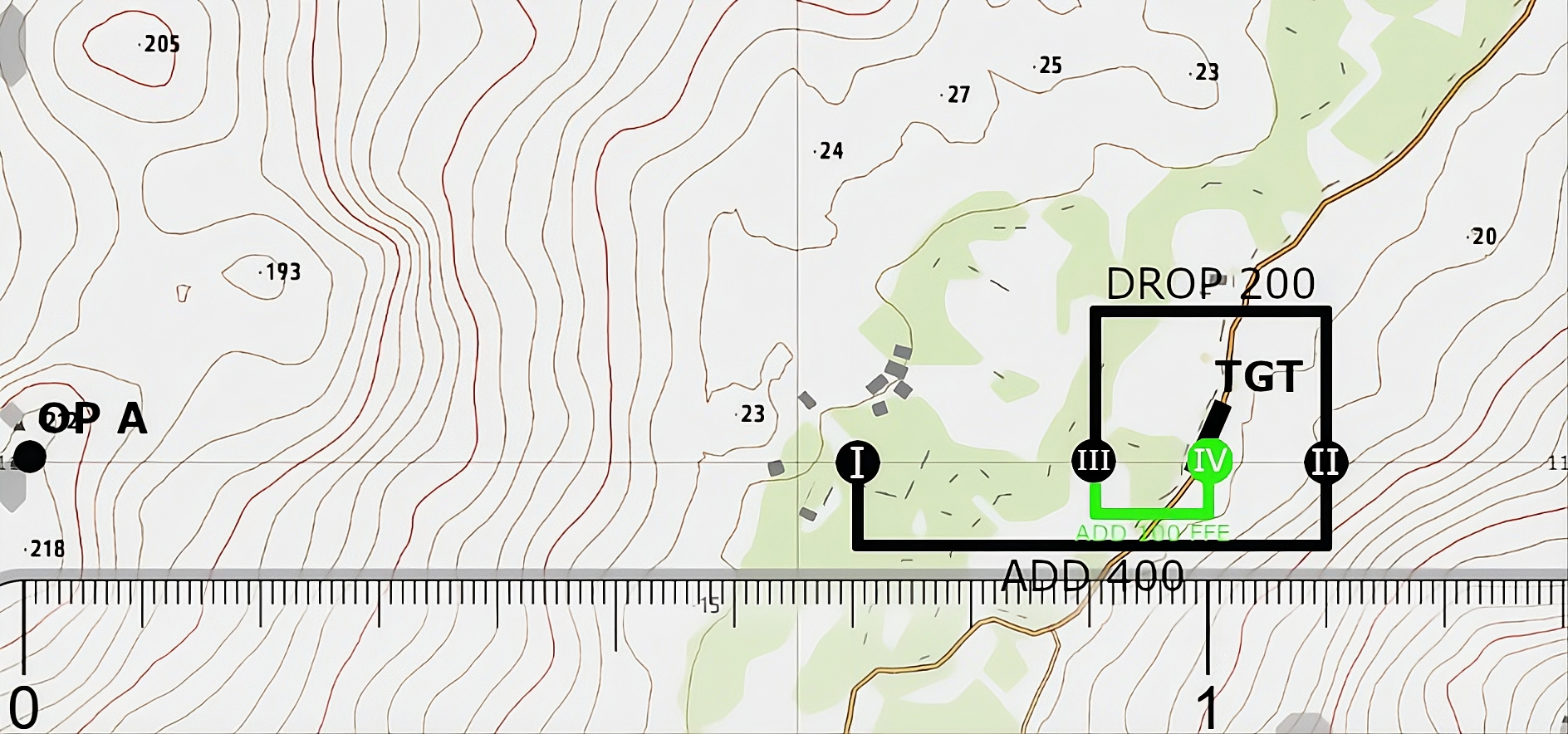
In this example our friends at OP Alpha have spotted an enemy convoy stopped on the road. They are clumsy so the left all their batteries at base and lost their maps but still remember their GRID. They estimate range to target to be 700 meters. They call CFF.
After some time the first rounds hit at point I. They can tell they fell short so they Add 400. Those go far in II, so they call Drop 200. After shells land in III, they call Add 100 and Fire for Effect hitting IV and destroying the enemy convoy.
Now they can RTB and get screamed at by their senior NCOs for losing the gear.

1 Comment
Recommended Comments
Join the conversation
You are posting as a guest. If you have an account, sign in now to post with your account.
Note: Your post will require moderator approval before it will be visible.